Calipers, Cable Lengths and a Cardboard Gauge: Naming the Strangers in Your Needle Drawer
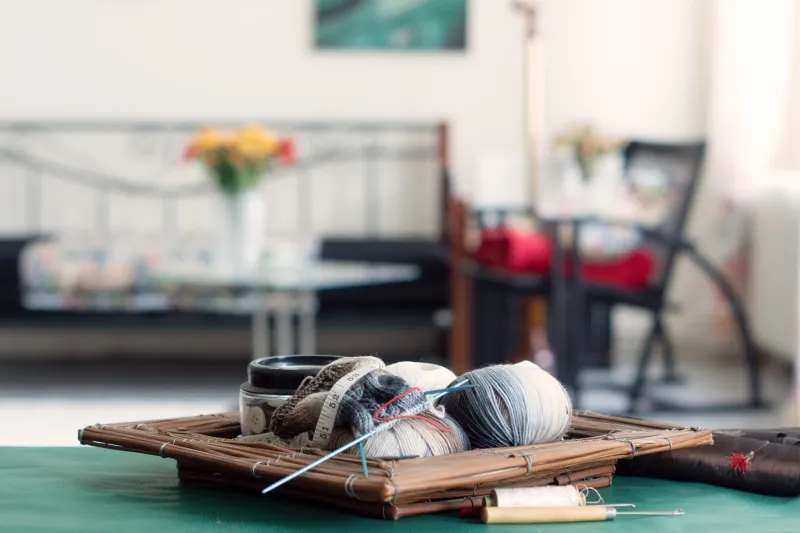
We have all got one. A drawer, a tin, a biscuit barrel that once held something altogether more interesting, now home to a tangle of circulars in unmarked packets, a handful of straight needles with the numbers worn off, and three crochet hooks of uncertain parentage. Nobody remembers buying them. Some clearly came from a relative. One appears to be made of something that might be bone.
You could tip the lot into a charity bag and start again, and I would not judge you. But most of these tools are perfectly good — they simply need identifying. Set aside an evening, put the kettle on, and work through it methodically. It is oddly satisfying work, somewhere between sorting a button tin and solving a small, woolly puzzle.
Start with the easy wins
Before you reach for any equipment, sort the pile into three groups: circulars, straights (including double-pointed), and hooks. Then look closely at each one. Most needles carry their size somewhere — stamped into the metal near the tip, printed on the cable, or moulded into the plastic. Light and a magnifying glass will rescue more of these than you would expect, especially on older aluminium, where the number is often there but simply filled with decades of lanolin and dust. A wipe with a cloth and a drop of washing-up liquid brings a surprising number back from the dead.
Set aside anything that gives up its secret immediately. What is left is your mystery pile, and that is where the real detective work begins.
The caliper method (with a hardware-shop shortcut)
Digital calipers cost about the price of a decent ball of sock yarn, and they will pay for themselves the first time you avoid knitting a whole jumper on the wrong size. Measure across the shaft of the needle — the working part, not the tapered point — and you will get a reading in millimetres. Round it to the nearest standard size: 3.25mm, 3.75mm, 4mm, 4.5mm and so on.
If you do not fancy buying calipers, a set of drill bits works beautifully. Slide the shaft of the needle into the shank of each bit until you find the one it fits snugly; the bit is stamped with its size, and your needle is that size too. It is the sort of trick that sounds faintly ridiculous until you try it, at which point you wonder why you ever did anything else.
One caution: wooden and bamboo needles swell and wear, so a 4mm that has seen ten years of service may measure 3.9mm or 4.1mm. That is fine. You are looking for the nearest named size, not laboratory precision.
Make yourself a gauge card
This is the single most useful thing you can keep in the drawer. Take a piece of rigid card — the back of an old notebook is ideal — and cut a series of narrow slots along one edge, each one matching a standard needle size, labelled in millimetres. Then punch a row of holes in the card, again sized and labelled. Needles slide into the slots; hooks poke through the holes. In thirty seconds you can size a whole handful without thinking.
Laminate it, or cover it in clear sticky-backed plastic, and keep it in the drawer rather than in a folder. A gauge card that lives somewhere sensible gets used; one filed away in a project bag does not.
Cables: measure the cord, not the whole thing
Circular needles trip people up constantly because the number printed on the packet refers to the total length — tip to tip — while what you actually need to know for a pattern is usually the cord length, since that dictates how many stitches will comfortably sit on the needle.
Measure from the join on one side to the join on the other to get the cord length. Add roughly 13–14cm for a standard pair of tips, or simply measure the full length and subtract. Write the result on a small paper tag, loop it through the cable, and knot it on. Circulars sold in interchangeable sets often have colour-coded cords, which is lovely until you have two brands in the same drawer and the colours mean different things.
When there are no markings at all
Some needles are genuinely anonymous — vintage straights with the number worn smooth, or hooks picked up at a boot sale in a bundle. Here is where a little historical knowledge helps. Older British needles were sized the opposite way round to modern ones: a UK 12 is fine, around 2.75mm, while a UK 4 is a chunky 6mm. So if you find a tin of ancient Aero or Milward needles marked with numbers in the low teens, do not assume they are colossal — they are delicate little things, the sort your grandmother used for fine gloves.
Steel crochet hooks for thread work follow the same logic, numbered 14 down to 0.5 or so, where a higher number means a finer hook. Modern hooks, thankfully, are nearly always stamped in millimetres near the throat.
The swatch test for the truly stubborn
If a needle resists every measurement, knit a small square — say twenty stitches by twenty rows — on it, and compare the fabric with the same square worked on a needle you know the size of. Two swatches side by side will tell you more about a needle's true behaviour than any number, because gauge depends on how you knit as much as on the tool. It also gives you a legitimate excuse to cast on something small on a Tuesday evening, which is never a bad thing.
Label it like future-you matters
Once a tool has a name, keep it. Masking tape and a fine permanent marker will do; a cheap label maker is nicer still. For circulars, write the size and cord length on a tag and attach it at the join. Store like with like — circulars in one zip pouch, straights in a roll, hooks in a case with elastic loops — and keep the gauge card on top, where it is the first thing you see.
If you are the sort of person who likes a record, photograph the labelled drawer and note the contents in your phone. It sounds excessive until the day you are standing in a yarn shop trying to remember whether you already own a 3.5mm in a 60cm cord. (You do. You always do.)
The drawer that stays sorted
An hour's work, a fiver's worth of calipers and a scrap of cardboard will convert a drawer of strangers into a working tool kit. There is a particular pleasure in opening that drawer and knowing, instantly, exactly what is in there — no rummaging, no swearing, no casting on with a needle that turns out to be two sizes out.
And if one or two mysteries remain unsolved at the end of the evening? Keep them anyway. Every stash needs a little folklore.