Light, Chair, Basket, Repeat: How to Build a Winter Stitching Corner That Actually Works
There's a particular moment in early November when the crafting season properly begins. The clocks have gone back, it's pitch dark by half four, the radiator in the front room has started its familiar clanking, and the idea of an evening with a cup of tea and something on the needles suddenly seems like the best plan anyone has ever had.
Except, of course, the reality. You're squinting at navy wool under a ceiling light that flatters nothing. Your yarn is wedged between a stack of board games and a bag for life. And you've been sitting on a dining chair for two hours, which your lower back has opinions about.
A dedicated stitching corner doesn't need a spare room or a joiner. It needs four things: decent light, a chair that doesn't punish you, yarn that stays dry, and a system simple enough that you'll still be using it in February. Here's how we'd go about it.
Start with where you actually sit
Be honest about this bit. Most of us have a sofa we claim to craft on and a chair we actually craft in. Watch yourself for a week — where do you naturally land when you pick up your needles? That's your corner. Trying to build a stitching space somewhere you don't organically go is the single most common way these projects quietly die in January.
Once you've identified the spot, you're looking at a patch of floor roughly a metre square. That's plenty. A small side table, a lamp, a basket and somewhere to put your tea is genuinely the whole brief.
Light first, everything else second
If you only spend money on one thing this winter, spend it on light. Dark yarn in a dim room is the fastest route to miscrossed cables, eye strain and the sort of temper that makes you put a project in time-out for six months.
Ceiling lights are the problem, not the solution. A single pendant throws shadows straight down over your hands, which is precisely where you need to see. What you want is a task lamp you can angle in from over your shoulder, so light falls onto your work rather than behind it.
A few things worth looking for on the box:
- Colour temperature around 4000K. This is that neutral, slightly warm white that shows navy, charcoal and dark green yarn as they truly are. Anything much cooler turns everything a bit clinical; anything warmer flatters your wool but lies about your colourwork.
- A colour rendering index (CRI) of 90 or above. It's less talked about than lumens but it's the number that tells you whether reds and purples will look distinct. Cheap daylight bulbs often skimp on it.
- An adjustable arm and a decent spread. You want a pool of light roughly the width of a broadsheet, not a spotlight on a single stitch.
- Dimming, if you can. Full brightness at 9pm when you're winding down is not always the vibe.
Don't write off the cheap options. A clip-on lamp with a flexible neck from a hardware shop will do a surprisingly good job if you position it properly, and it's the sort of thing you can move to the arm of the sofa or the edge of a shelf. If you already own a floor lamp, try swapping the bulb for a high-CRI daylight one before you buy anything new — it's a few pounds and often the whole fix.
One more thing: keep a small pair of reading glasses or a clip-on magnifier in the basket. Very few of us admit we need them, and all of us work faster when we've got them.
The chair question
You don't need a wingback. You need something where your feet reach the floor, your shoulders are relaxed and your elbows aren't floating. For most knitters that means a chair with a seat height around 45cm, a bit of lumbar support and a footstool, because a raised knee takes the strain off your lower back when you're leaning over colourwork.
If you're working with a sofa, a firm cushion behind the small of your back changes more than you'd think. If you're improvising with a dining chair, add a folded throw and put your feet on a box. And if you're in the market for a second-hand armchair, charity shops and local Facebook groups are full of good solid ones in January when everyone's having a clear-out — check the frame and the springs rather than the upholstery, which can be covered.
Try to avoid the deep, low slung sofas that swallow you. They're lovely for films and hopeless for anything requiring you to see your hands.
Damp is the real enemy of a British yarn stash
This is the bit that rarely makes it into the pretty photographs, and it matters more here than almost anywhere. UK homes in winter are damp homes, and wool is a protein fibre that will happily drink up moisture and then develop a smell you can't get out of it.
A few rules we've learnt the hard way:
- Keep yarn out of lofts, garages and sheds. All three swing between cold and damp and back again. A spare bedroom wardrobe is a far better home than a beautifully organised loft.
- Never seal yarn into plastic crates unless it is bone dry. Airtight containers trap any moisture already in the fibre and give you a micro-climate. If you do use plastic boxes, add a couple of silica gel sachets and check them monthly.
- Cotton drawstring bags and breathable storage boxes are your friends. They let wool breathe and let you see what you've got, which is half the battle.
- Vacuum bags are fine for clean, dry, long-term stash — but don't crush natural fibres flat for years on end, and never store anything that's been worn or gifted without airing it first.
- Watch the windowsill. That condensation you wipe off the glass in the morning is sitting right next to the yarn you've stacked underneath it.
- Deal with moths early. Cedar blocks, lavender bags and a monthly shuffle through your stash are cheap insurance. If you find a hole, isolate everything nearby straight away.
Label things, too. A five-second note on a luggage tag — fibre, weight, metreage, where it came from — saves an entire evening of guessing later.
Build a basket system you'll keep up with
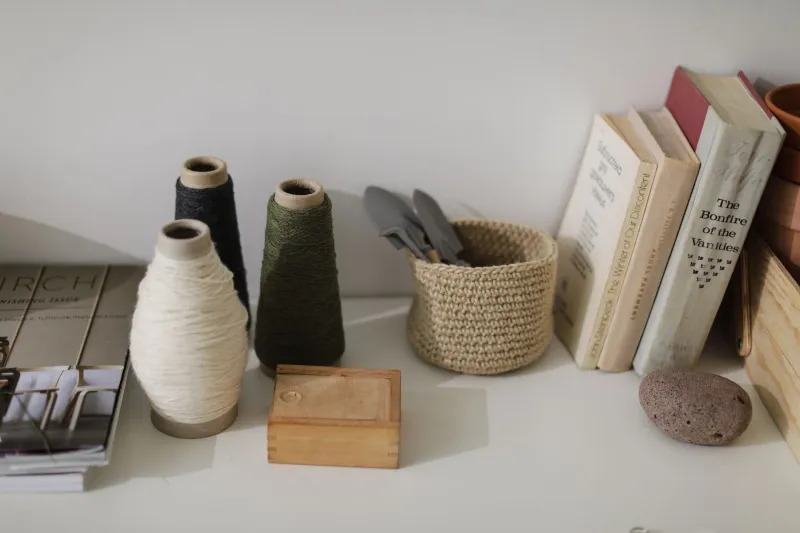
Project bags are lovely, but a basket is better for a corner because you can see into it. The rule that works best: one basket, one project. Not one basket for all your WIPs, which turns into a lucky dip, but a single shallow basket per project that lives on the shelf or under the table.
Into each basket goes the yarn, the pattern (in a plastic wallet — those paper printouts and condensation don't mix), the relevant needles and notions, and a small tin or pouch for the bits: stitch markers, a darning needle, a crochet hook for picking up dropped stitches, a tape measure, a couple of stitch holders. When you want to work on something, you pull out one basket. When you finish for the night, you put it back. That's the whole system, and its simplicity is why it survives.
A separate shallow tray on the side table for the current project is a nice touch — it stops the sofa getting colonised by loose balls of yarn and stray cable needles.
Budget upgrades worth the money
If you're spending this month, here's roughly where we'd put it, in order:
- A decent task lamp or a high-CRI bulb — the biggest single improvement per pound.
- A footstool or firm cushion — cheap, and it changes how long you can comfortably sit.
- A shallow wicker or felt basket or two — supermarkets, homeware shops and charity shops all have them for under a tenner.
- A small shelf or a couple of magazine files — gets patterns and reference books off the floor and out of the way.
- A magnetic tin for pins and markers — sounds trivial, saves you crawling about on the carpet.
A pegboard on the wall behind your chair is the classic finishing touch, and genuinely useful for hanging a small ruler, scissors on a string and a needle gauge. But it's a nice-to-have, not a starting point. Get the light right first.
Your November-evening checklist
- Sit in your chosen spot for ten minutes and note where the shadows fall.
- Move or add a lamp so the light comes over your shoulder, not from above.
- Swap the bulb for a 4000K, high-CRI one if you're not buying a new lamp.
- Put something firm behind your lower back and something under your feet.
- Pull every yarn bag out of the loft, garage or shed and bring it somewhere dry.
- Check for damp, moths and mystery unlabelled balls; air anything that smells fusty.
- Label your yarn, then put it in breathable boxes or bags.
- Assemble one basket per active project, with notions included.
- Clear the side table of everything that isn't stitching-related.
- Make a brew, cast on, and call it a job well done.
The best stitching corner isn't the prettiest one on the internet. It's the one where you can see your stitches, your back doesn't ache, your wool is dry and everything you need is within arm's reach. Get those four sorted before the really dark evenings arrive, and you'll have somewhere to hide from the winter in the best possible way.