Odd Balls and Boot-Sale Gold: A Saturday Guide to Rescuing Second-Hand Yarn
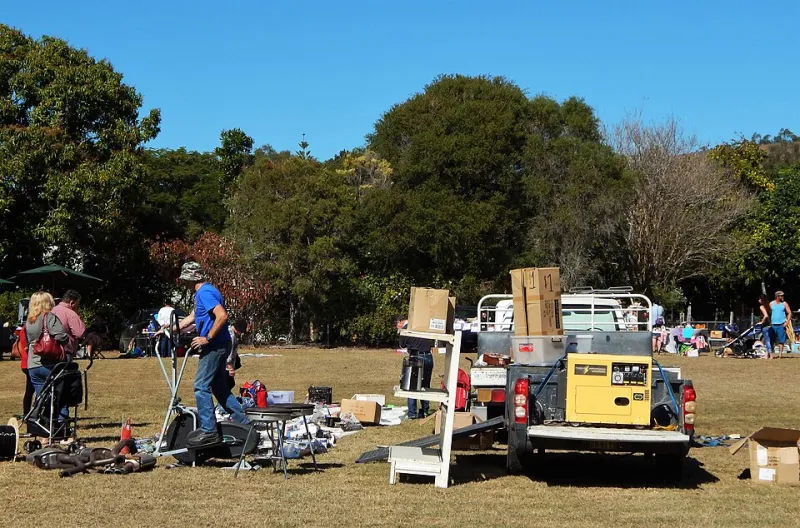
Photo: RegionalQueenslander, CC BY-SA 4.0, via Wikimedia Commons
There's a particular sound a car boot sale makes at half past seven on a Saturday morning: tarpaulins being shaken out, thermos lids being unscrewed, and someone asking a stranger whether they'd take three pounds for the whole tub. If you knit or crochet, that last sound is your cue to lean in. Because somewhere in that tub — under the novelty pasta maker and the boxed VHS tapes — there are usually four or five perfectly decent balls of yarn going for the price of a coffee.
Second-hand yarn is having a quiet moment. Destashes on local selling pages, carrier bags at the back of village halls, the craft shelf in the charity shop that nobody quite knows what to do with. Some of it is tat. Some of it is the nicest wool you'll handle all year. The trick is knowing which is which, and having a plan for the moment it comes home with you.
Why the good stuff rarely comes in a sealed bag
New yarn is a lovely thing: matched, labelled, the right number of balls for the pattern on the front. But the yarn that turns up at a jumble sale has usually fallen out of a real person's stash — a cardigan they never finished, a jumper's worth of something discontinued in 1998, a mill end bought by the sack. That's where the interesting colours live, the ones the big shops rotated out years ago and never brought back.
There's also the money. A ball that cost seven or eight pounds new can sit on a charity shop shelf at a pound, and a boot-sale job lot of ten for a fiver is not unusual. And for anyone trying to keep their hobby off the fast-fashion treadmill, a rescued skein is a small, satisfying act of re-use.
Plan the route before you set the alarm
Treat it as a proper day out and you'll come home with more than a headache. A workable circuit looks like this: car boot first thing (doors open early, best picking between seven and nine), then charity shops mid-morning once the volunteers have finished sorting, then any jumble sale or church-hall tabletop sale advertised in the parish magazine or on a laminated notice in the post office window.
Take cash in small notes, a sturdy tote, hand gel, a bottle of water and a notebook — you'll want to write down what you paid and where, if only to gloat later. Wear something with pockets.
Boot-sale tactics that actually work
Early birds get first pick, but the last hour gets the bargains. Dealers rarely want a bag of unlabelled yarn, so if you spot a tub at nine o'clock, come back at twelve and ask what they'd take for it. Haggling is expected; be cheerful about it.
Ask directly: 'Have you got any wool or knitting bits?' Half the time the answer is a box under the table. Have a good feel rather than a quick glance — acrylic squeaks slightly when you rub it, wool feels warmer and springs back when you stretch it. Cone yarn from machine knitters turns up regularly and can be a genuine find, though it's often oiled and needs a wash.
The charity shop circuit
Charity shops price yarn wildly — anything from 50p a ball to a fiver for a bag. Do ask if there's more out the back; donations are sorted into boxes and the craft items often linger. If a bag contains someone's abandoned project, complete with the pattern, that's often a good sign: the yarn has been bought together and the colours have been chosen to work.
And remember these shops exist to fund something. If the price feels low, round it up. You'll still be ahead.
Fibre detective: working out what you've got
Most rescued yarn arrives without a band. A few quick tests will get you most of the way:
- Check the ball band remnants. Shade and dye lot numbers are usually printed at both ends, so one surviving wrapper often tells you everything.
- The burn test. Snip a small length, hold it with tweezers over a sink or step outside, and light it. Wool smells of burnt hair and crumbles to ash; acrylic melts, smells chemical and forms a hard bead. Do this only on a tiny piece, and never near anything flammable.
- The stretch test. Pull a strand and let go. Wool and most animal fibres spring back; cotton and linen don't much; superwash wool snaps back but feels smoother and slicks apart if you try to felt it.
- The rub test. Wet a short length between your palms. If it starts to mat together, there's wool in there.
If you're still unsure, assume it's a blend and treat it gently. Nothing bad happens to a mixed fibre washed kindly.
The moth question
This is the one worth taking seriously. Look for tiny holes, fine webbing in the folds, a gritty dust that could be frass, or a musty, dusty smell. If you find any of that, either walk away or bag it tightly, take it straight to the bin and wash your hands.
If it looks clean but you're suspicious, quarantine it. Pop the yarn in a sealed freezer bag, squeeze the air out, and freeze for at least 72 hours. Some people do two rounds with a thaw in between, which catches eggs that survived the first spell. Then wash it before it goes anywhere near your stash.
Washing mystery wool without tears
Fill a basin with cool water and a drop of wool wash. No detergent, no fabric softener, no agitation. Leave the skeins to soak for twenty minutes, press them gently under the water, then lift them out supporting the weight with both hands. Rinse in water of the same temperature — sudden changes are what felts wool. Roll in a towel to blot, then dry flat, away from radiators, and never on a hanger.
For a smoky or fusty smell, add a splash of white vinegar to the rinse. For anything alarming, wash a single test skein first and see how it behaves before committing the whole haul.
What to make with a mismatched pile
Odd yardage and mismatched dye lots don't suit a fitted jumper in one colour. They suit plenty of other things:
- Stripes, especially with a neutral to hold them together
- Colourwork yokes, where small amounts go a long way
- Mitred squares, log cabin blankets and Ten Stitch projects
- Slip-stitch patterns, which look far more complicated than they are
- Holding two strands together to blend colours and hit a gauge
Swatch a decent-sized square and accept that the gauge may not match the pattern. Buy patterns by yardage rather than by ball count, and be willing to change needle size until the fabric feels right.
Log it, store it, pass it on
Wind what you keep into cakes, jot the fibre and rough yardage on a luggage tag, and keep it in a sealed box with a cedar block or a lavender bag. Anything you know you'll never use goes into a swap box at your local group — someone will have a use for it, and the yarn keeps moving.
The best skein in your stash probably didn't come from a shop with a till and a carrier bag. It came out of a plastic tub on a wet Saturday, smelling faintly of someone else's attic, and it cost less than the tea you drank afterwards. That's not a compromise. That's a good day out.